Trust
What to publish about retreat safety before anyone asks
A safety page is not a legal shield. It is the page that decides whether a first-time guest sends a deposit or keeps reading three other centers, and most of them say nothing checkable.
The short answer
- Most centers publish safety as a disclaimer. Guests read disclaimers as an absence of information, and move on.
- Eight specifics do the work: screening criteria, medication policy, who is in the room, ratios, medical cover, distance to hospital, what is refused, and what happens in a crisis.
- Publishing your refusal criteria (who you turn away) is the strongest single trust signal a retreat page can carry.
- These are also the exact sentences AI assistants can lift, so the page earns visibility as well as deposits.
Why the safety page converts
A first-time guest arrives at your site carrying one question that outranks every other: is this going to hurt me. Everything else is downstream of it: the food, the setting, the lineage, the price. Yet the typical center answers that question with two sentences about how ayahuasca has been used for centuries and a link to a waiver.
We have watched this in screening calls. When a guest has read a detailed safety page before the call, the call is about dates. When they have not, the first fifteen minutes are spent covering material that should have been on the site, and a meaningful share of those calls end with “I need to think about it”. The page is not an obligation. It is the thing that gets a call to be about dates.
It also arrives at the right moment in the decision. As covered in how long a guest takes to book, weeks four to eight of the window are spent verifying claims rather than reading marketing. A safety page is the only page you control that is built for that phase.
Vagueness reads as concealment. In this market a guest assumes that anything you did not state, you had a reason for not stating.
The eight specifics worth publishing
These are the eight items that come up in inquiries and screening calls with enough regularity to justify permanent pages. Publish them as facts with numbers, not as reassurances.
- Screening criteria. The actual conditions that disqualify someone, named. Cardiac conditions, personal or family history of psychosis, current pregnancy. Not “we screen carefully”.
- Medication policy. Which classes require a taper and how long. SSRIs, MAOIs, lithium, tramadol, stimulants. State the taper length you require and who supervises it. Say plainly that you do not instruct anyone to stop prescribed medication without their prescriber.
- Who is in the room. Names, years of practice, the tradition or lineage, whether they are present for the entire ceremony. Anonymous “experienced shamans” is the weakest form of this claim.
- Ratios. Facilitators and support staff per guest during ceremony, and how many guests are in a ceremony at maximum. A number here is worth several paragraphs of atmosphere.
- Medical cover. Whether a nurse or physician is on site or on call, what medical equipment is present, and what training the staff hold. If the answer is a first-aid certificate and a satellite phone, say so. An honest limitation beats an implied hospital.
- Distance to definitive care. Time to the nearest clinic and to the nearest hospital, by the transport actually available. This is one of the most searched and least published facts in the industry.
- What happens in a crisis. The plan for a difficult ceremony, a medical event, and an evacuation. In writing, in order.
- Integration and aftercare. What support exists in the days after, and for how long after departure. Increasingly this is what separates two otherwise similar centers.

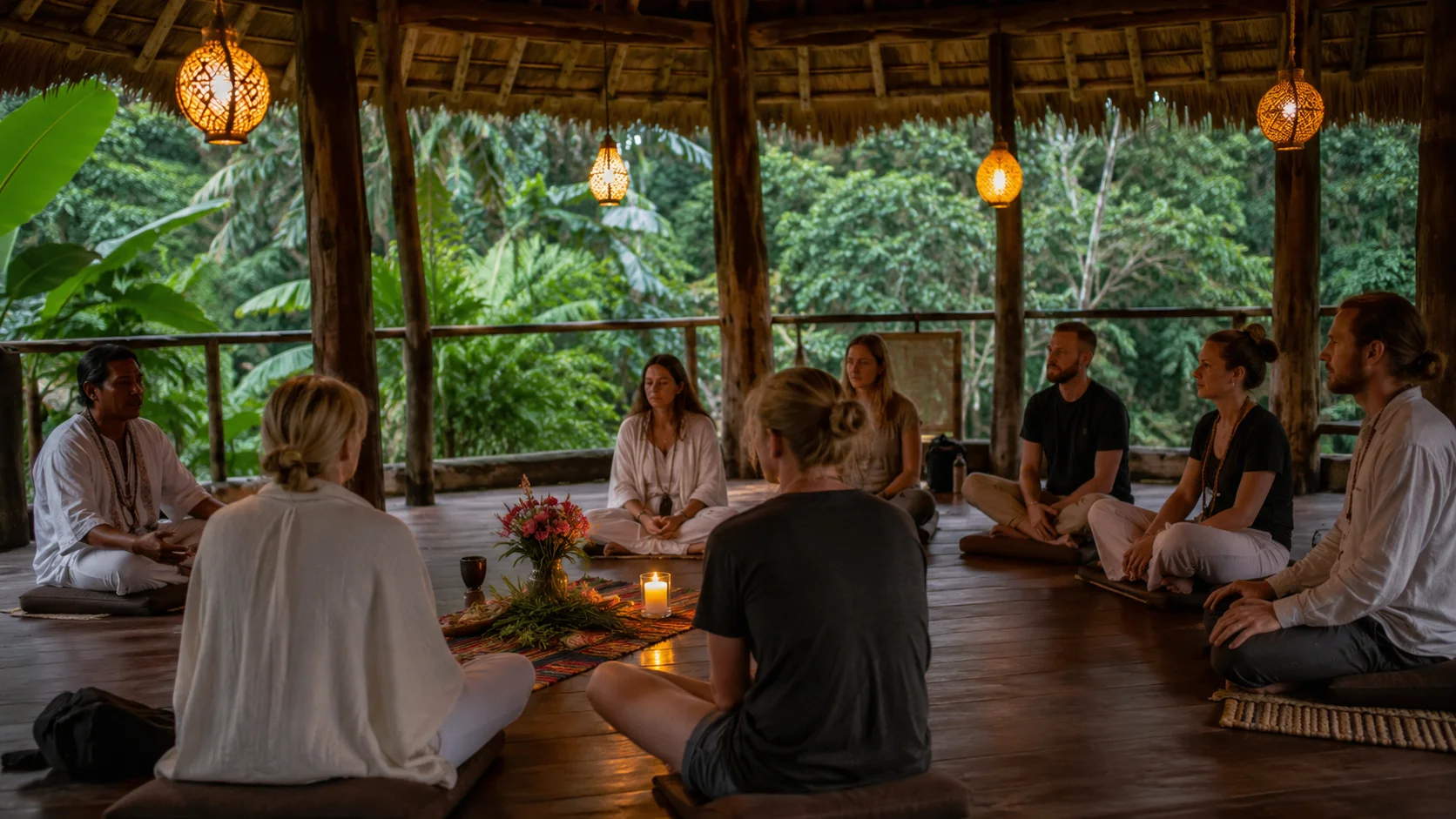
The screening conversation, photographed in daylight. Show the part of the work that is administrative and careful.
For the medical and pharmacological material, point to independent sources rather than asserting it yourself. The harm-reduction documentation maintained by ICEERS on ayahuasca and its interactions is a reasonable public reference, and MAPS publishes ongoing psychedelic research that a cautious reader will recognize. Citing outward is a trust signal; it shows you are not the only source for claims about your own safety.
Publishing what you refuse
The strongest paragraph on any retreat site is the one that describes who is turned away. It works for three reasons. It proves screening exists, since a center that refuses nobody screens nobody. It filters your inquiry pipeline before it costs you time. And it signals that you are prepared to lose revenue on principle, which is the specific thing a nervous guest is trying to establish about you.
It should be concrete: the conditions, the medications, the situations. Include the non-medical refusals too: someone in acute crisis looking for a substitute for treatment, someone sent by a family member rather than choosing to come, someone whose expectation is a cure. Centers that publish this consistently report fewer inquiries and a higher deposit rate on the ones that remain.
How to write it
- Numbers over adjectives. “Two facilitators and one support person for a maximum of twelve guests” instead of “attentive support throughout”.
- Short declarative sentences. Each one should be able to stand alone if lifted out of the page, which is how both skimming readers and AI assistants consume it.
- Name the limits. A clinic ninety minutes away is a fact worth stating. A reader who finds it out later finds it out as a discovery.
- Date the page. A last-reviewed date on a safety page is read as evidence of maintenance.
- Do not aestheticize it. This is the one page on the site where photography should be plain and the prose should be flat. It reads as competence.
Where legal caution belongs
Legal review belongs on this page, but a lawyer’s instinct to say as little as possible works against you here. The workable division: be maximally specific about process (screening, staffing, ratios, protocols, distances) and refuse to make any claim about outcomes. No therapeutic promises, no medical claims, no comparison to treatment. Specific about what you do, silent about what it will do for anyone.
That split also keeps the page consistent with how the rest of the site should read. It is the same discipline behind branding that avoids healing claims while still sounding like it means something.
Why assistants quote this page more than any other
When someone asks an assistant which centers screen for cardiac conditions, or how far a lodge is from a hospital, the model needs a page that states a checkable fact in a single sentence. Atmospheric copy offers nothing to lift. A safety page written the way described above is the densest concentration of quotable, verifiable sentences on a retreat site, which is why it is often the first page of a center to be named in an AI answer.
That makes it unusual: a page that increases deposits from readers who find it, and increases the number of readers who find you. Very little else on a retreat site does both.
Questions owners ask about this
What should an ayahuasca retreat safety page include?
Screening criteria, medication and taper policy, named facilitators with years of practice, facilitator-to-guest ratios, medical cover on site, travel time to the nearest clinic and hospital, the written crisis and evacuation plan, and what aftercare exists. State each as a fact with numbers rather than as reassurance.
Does publishing refusal criteria reduce bookings?
It reduces inquiries and usually raises the deposit rate on the ones that remain. A center that publishes who it turns away proves that screening exists, filters poor-fit inquiries before they cost staff time, and signals a willingness to lose revenue on principle.
Should we publish how far we are from a hospital?
Yes. It is one of the most searched and least published facts in the industry, and a reader who discovers a ninety-minute transfer after booking experiences it as concealment. State the time by the transport actually available.
Can we make claims about healing or treatment on a safety page?
No. Be maximally specific about process and entirely silent about outcomes. Detailed screening, staffing and protocol information with no therapeutic or medical claims is both the safer legal position and the more credible page.
Why do AI assistants tend to quote the safety page?
Because it contains the highest density of short, checkable, self-contained sentences on a retreat site. Assistants lift specific facts; atmospheric copy gives them nothing to lift.
Keep reading
Demand
What Is an Ayahuasca Retreat Center?
An ayahuasca retreat center is a dedicated setting where people participate in guided ceremonies involving ayahuasca,
Uncategorized
Hello world!
Welcome to WordPress. This is your first post. Edit or delete it, then start writing!
Book a growth call
Want this applied to your center
Fifteen minutes, free. Bring your inquiry count, your deposit rate and your published calendar. We will tell you which of these applies to you first, and roughly what it is worth.